

Great in small, a piece of city history in paper
Imagine a small wooden box, no bigger than a book, with a tiny world behind the glass. A frozen canal with skaters, a ship furling its sails, a cityscape, or a cozy scene in a living room. This isn’t a toy, but a bavelaartje—a typical Dutch artwork from the early 19th century.
They owe their name to Cornelis Bavelaar, a carpenter’s apprentice and artistic craftsman from Leiden, and his father, sculptor Cornelis the Elder. Together, they brought these unique viewing boxes to life. Later, Cornelis’s son, Joannes Franciscus, continued the tradition as the third and final generation of bavelaar makers.
A bavelaartje is small—usually about 12 by 18 centimeters, with a depth of five centimeters. Yet, inside it lies a complete world, composed of figures just 10 to 15 millimeters high. These minuscule people and animals were carved from wood, whalebone, or ivory, and sometimes even paper or straw. Backgrounds and details were often painted in dark tin, blue or black, adding depth to the scenes.
It’s estimated that around 1,500 bavelaartjes were made in total. Today, only about 350 are known to exist, scattered across museums and private collections. They once fetched 8 to 12 guilders; now they are rare, highly valuable collector’s items.
The bavelaartje is more than a curiosity: it’s a window into daily life some 200 years ago, captured in miniature.
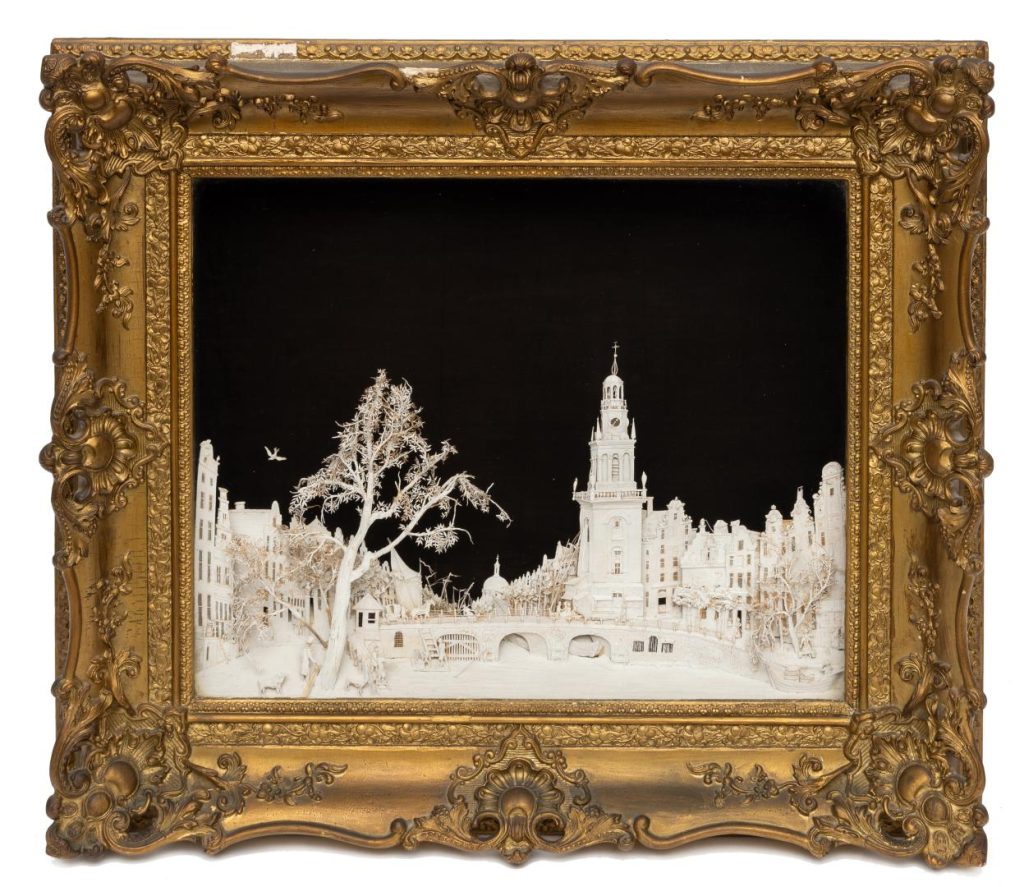
The Bavelaar we offer under lot number 1968 was not made by the Bavelaar family, but by Hendrick Berck and dated 1828. It depicts an Amsterdam cityscape with figures. We see a lady carrying buckets on a yoke, a horse-drawn sleigh, and various people walking, some accompanied by their dogs. The scene is set around a canal, how could it be otherwise? However, it’s not just any canal; it’s a view of the Singel canal, at the corner of Torensteeg, with the Jan Roodepoortstoren, demolished in 1829, taking center stage. The Ronde Lutherse Kerk (Roman Lutheran Church) is also clearly visible in the background.
The realization that this bavelaar was made one year before the tower was demolished, and only two years after the rebuilding of the church, which had burned down in 1822, makes this little piece of the world captured in paper a unique piece of city history.